A repair shop with 265,000 impressions and 467 clicks
Computer Clinic Irvine was showing up in search a quarter of a million times a year and getting almost nothing for it. The site was a single page app that served crawlers an empty shell, the shop was pinned to the wrong location, and the copy made claims the owner could not stand behind. We rebuilt it as 64 pages of real HTML.
- 64 routes, all server rendered with their own metadata
- Business location corrected, previously off by 1.5 miles
- Unsupportable claims removed from every service page and 11 posts
- Search Console baseline: 265,758 impressions, 467 clicks, 0.18 percent
What was wrong
The numbers told the story before we opened the code. Over the previous 12 months the shop had earned 265,758 impressions in Google and 467 clicks. That is a click-through rate of 0.18 percent. Individual searches showed why: "data recovery irvine" sat at position 22, and the Mac repair page at position 32. Google knew the shop existed. Almost nobody ever saw it.
The site had been generated as a single page app, so every route rendered in the browser. Crawlers were handed a shell with no content in it. Whatever ranking the shop had, it had in spite of the site.
Two other problems mattered more than they look. The shop's coordinates were about a mile and a half off, so the map pointed somewhere it was not, and the map embeds were placeholders that never resolved to the real listing. And the copy claimed things the owner could not back up: thousands of customers, certified technicians, a 95 percent success rate, specific data recovery percentages, and a free diagnostic that contradicted the shop's own liquid damage policy.
What we built
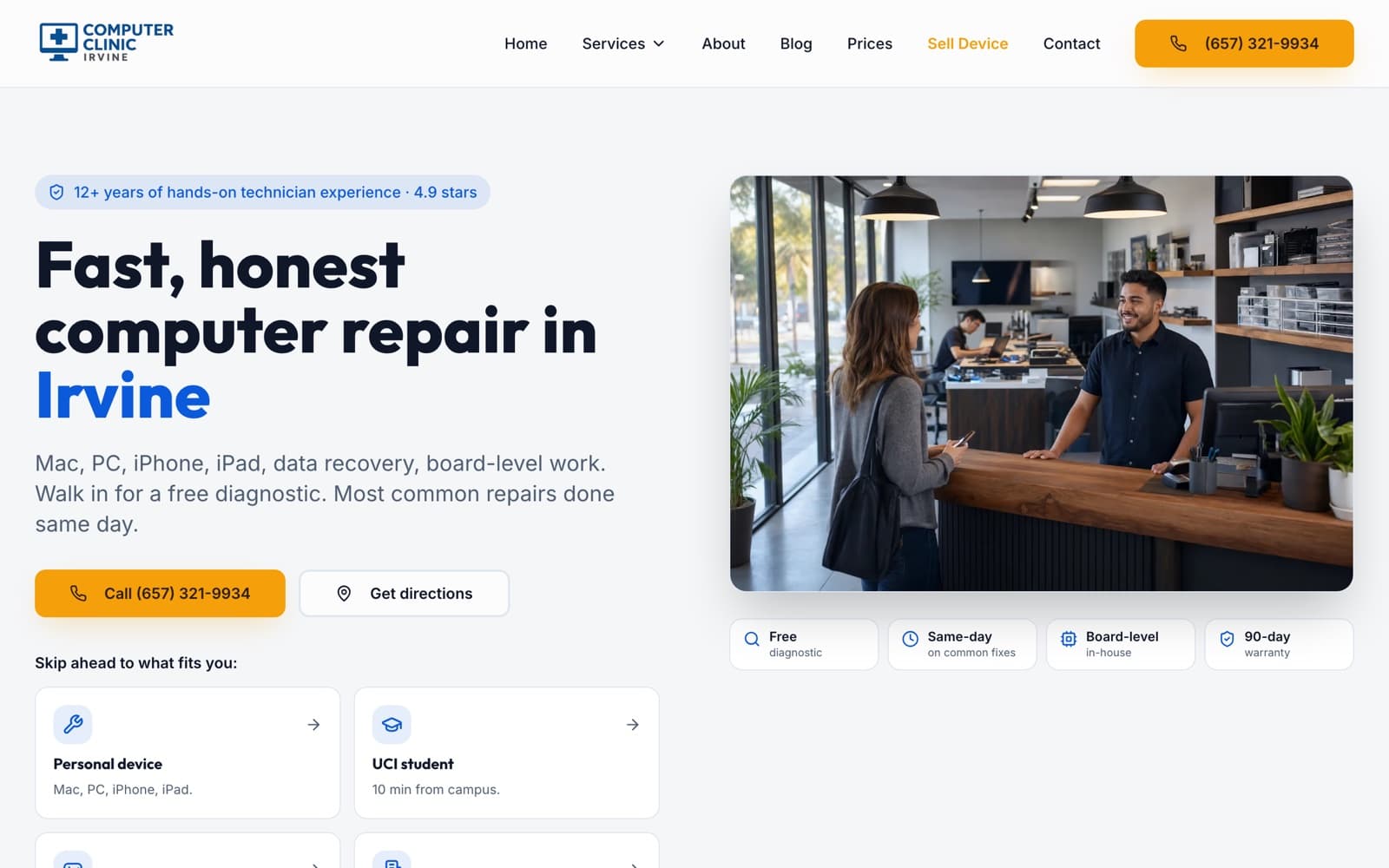
We migrated the site to a server rendered architecture using a codemod written for the job, which converted each client side view into a real page with its own metadata. The result is 64 routes, and every one of them now ships complete HTML with its own title, description, canonical, social tags and structured data.
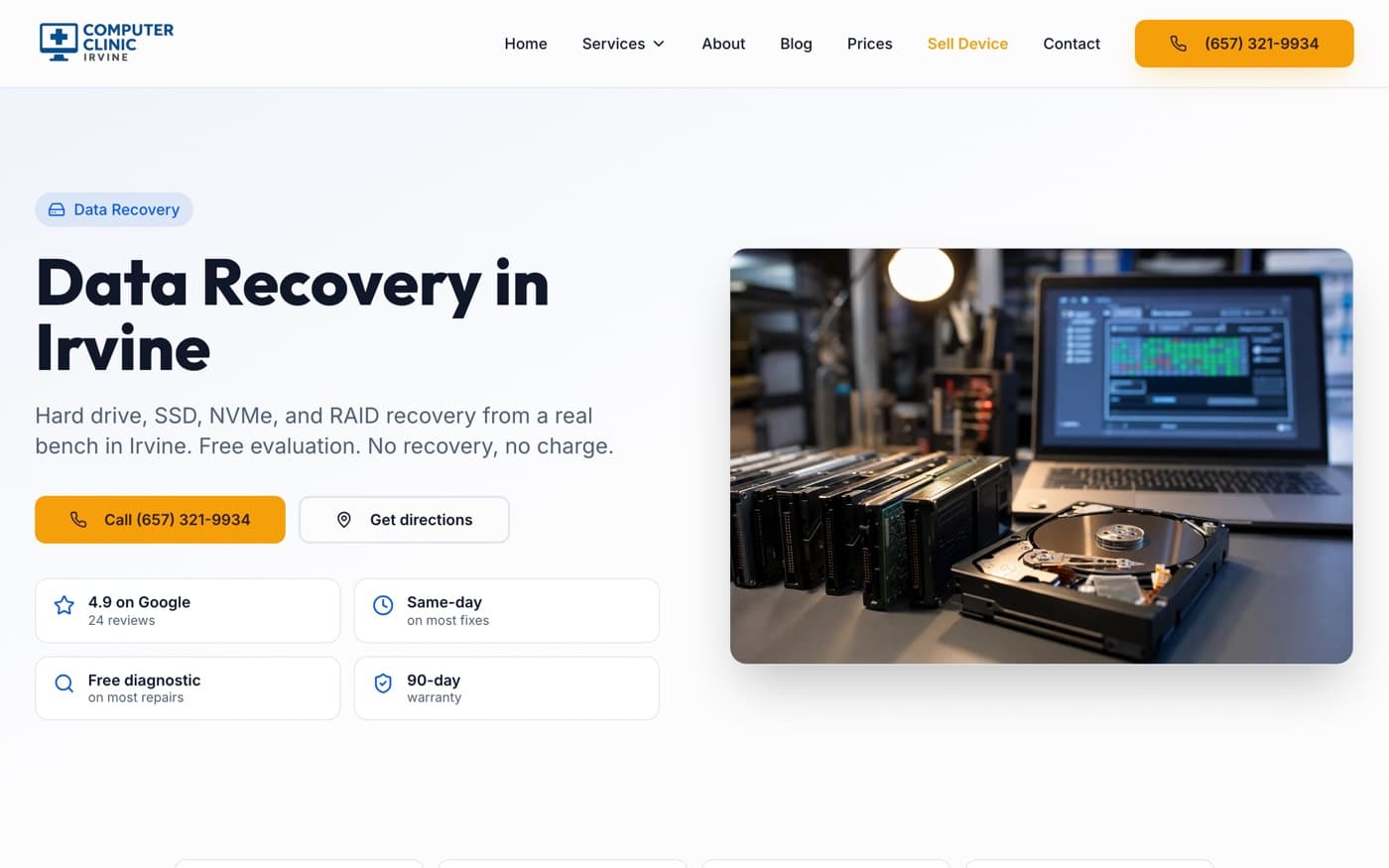
Fourteen service pages cover the actual work: computer repair, Mac and Apple, iPhone and iPad, iMac, data recovery, graphics card repair, micro soldering, virus removal, custom PC builds, console repair, hardware upgrades, network setup, and a page written specifically for UCI students, who are ten minutes away.
Eleven city pages sit under an Orange County parent. These are full local pages, not the same page with the city name swapped, which is a pattern Google treats as spam. Each one carries its own local context, trust signals, FAQs and driving directions by neighborhood. Two more clusters cover IT support and home networking, and the blog runs to 23 posts including board level repair write ups taken from real jobs.
Fixing what was claimed
We removed the fabricated statistics from the service pages and from 11 blog posts, and wrote a copy standard into the repository: no inflated review counts, no volume claims the shop cannot evidence, no filler. It is the same standard we hold ourselves to.
This matters beyond ethics. A shop that claims a 95 percent success rate and then cannot deliver it generates the kind of review that costs far more than the claim ever earned.
Getting found
The site carries a sitewide structured data graph identifying the business, its real coordinates, hours, service area and profiles, rendered on the server on every page. City pages carry their own local business schema.
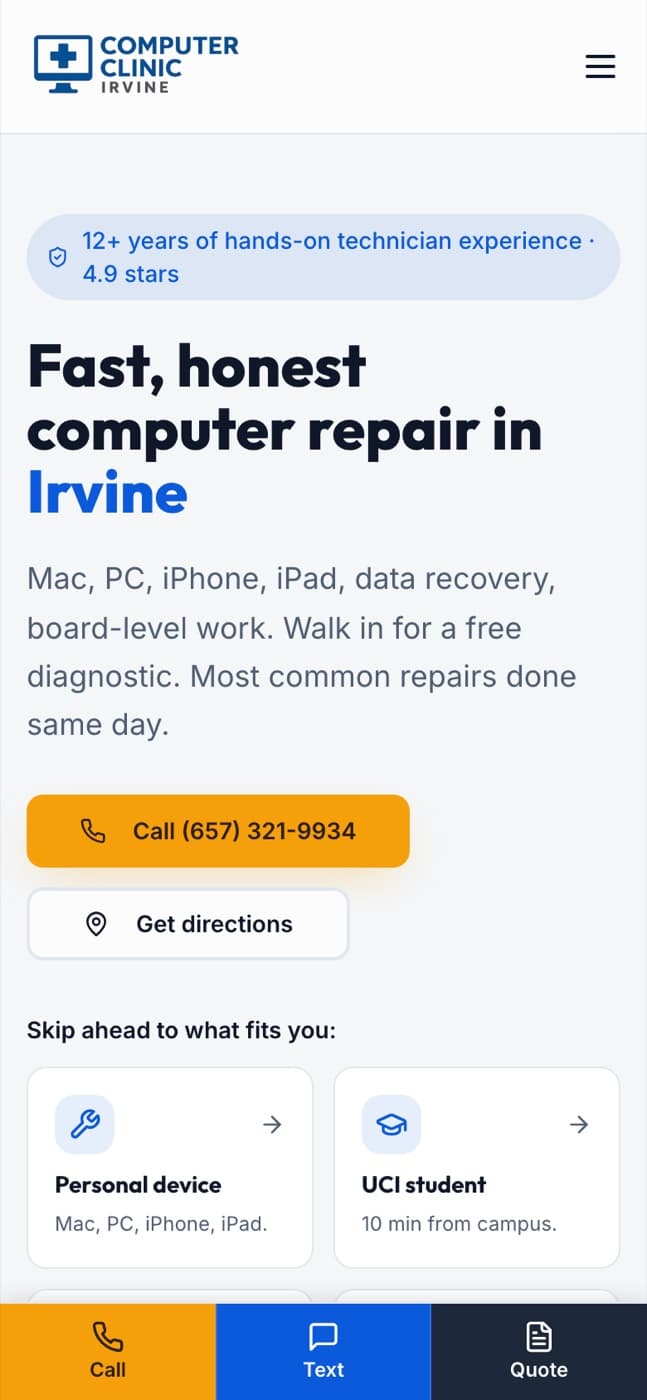
Images ship as AVIF and WebP at responsive sizes with explicit dimensions so the layout does not shift while loading. The heavy third party form script loads only when needed. Contrast was reworked to pass WCAG AA.
We also wrote the crawler rules to allow the AI search engines by name, and published plain text summaries of the business for them to read.
What we handed over
Beyond the site: a search roadmap tied to the actual Search Console data with work logged against commits, a review growth playbook with a printable counter card, and 21 ready to post social graphics with captions and a short guide written for whoever runs the shop's social accounts.
Questions
What is this site built with?
Next.js 16 with the App Router, server rendered so that all 64 pages ship complete HTML to every visitor and every crawler. The previous version was a single page app that rendered only in the browser.
Why does a repair shop need 64 pages?
Because people search for the specific thing they need, not for a shop. Fourteen service pages cover the actual work, from data recovery to micro soldering, and 11 city pages cover the surrounding towns. Each one is a real page with its own local context rather than the same page with the city name swapped, which Google treats as spam.
Do clients own the sites you build?
Yes. The domain, the code, the content and the analytics all belong to the client. If we ever part ways, everything keeps working and any competent developer can take it over.
Can you build something like this for my business?
Yes. We work with local businesses across the United States, and every project starts with the same discovery and strategy work. Tell us about your business and we will tell you honestly whether we are the right fit.